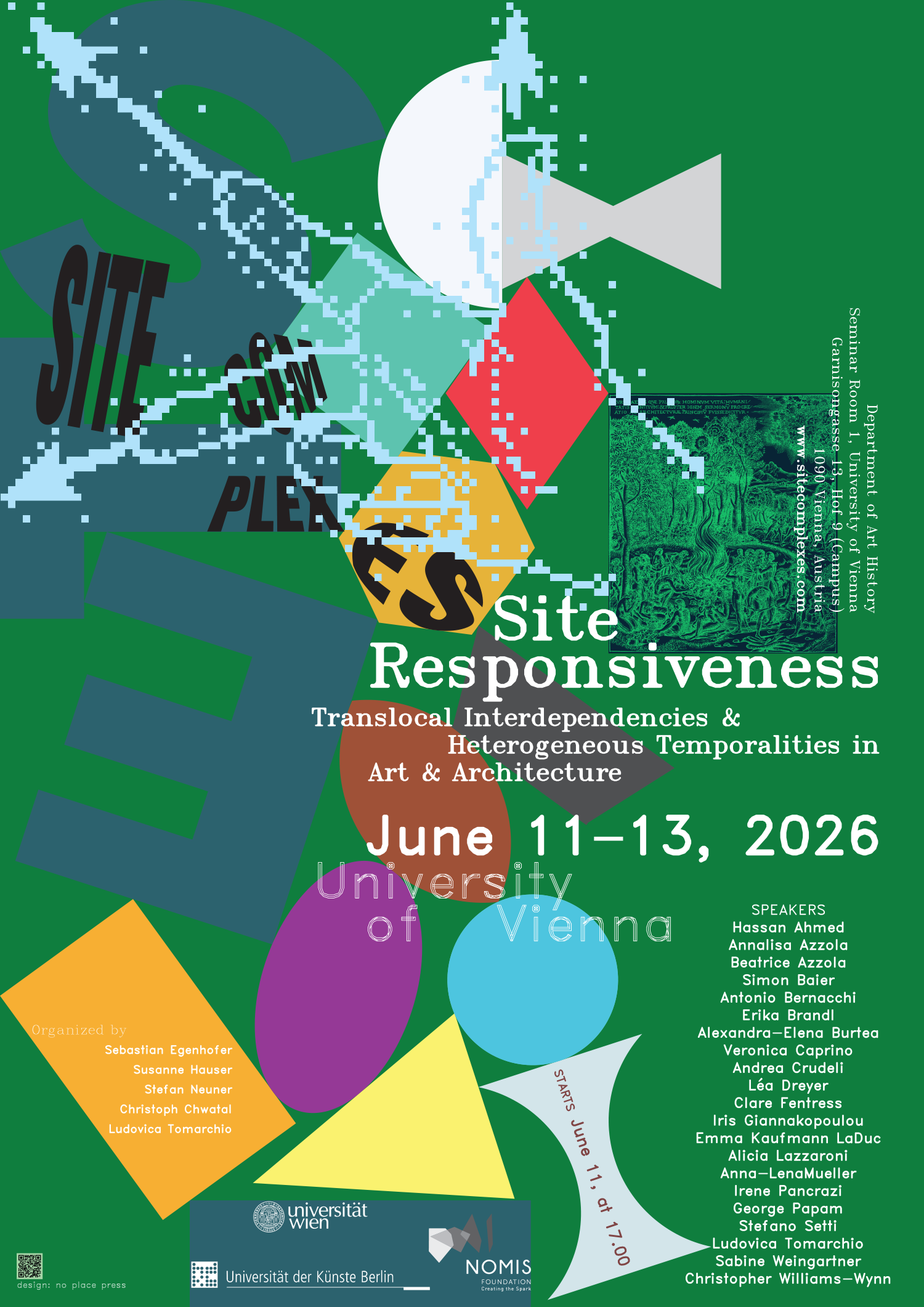
It is a widely shared diagnosis that translocal connectivity and interdependence of events are defining characteristics of our present. Beyond increasingly powerful infrastructures for the transport of goods and data, and a globally synchronized information sphere, this condition is shaped by the destabilization of both the planetary and many local ecosystems. Against this backdrop, the concept of the site requires a fundamental revision. Sites can no longer be understood as fixed anchor points or stable stages for events. Instead they are nodes where diverse diverse but interdependent processes overlap — ranging from high frequency digital data flows to slow ecological transformations.
This conference explores how art and architecture have responded to this dynamism and translocal interdependence Since the 1960s, “site-specific” approaches have evolved from mainly material and spatial definitions toward social, ecological, and infrastructural conceptions. We focus on cases in which the complexity of the site becomes fully operative, foregrounding the multiplicity and heterogeneity of the forces that constitute it.
Shifting from site specificity to site responsiveness, the conference highlights practices that do not simply adapt to sites but actively reconfigure the processes that shape them — creating new couplings, exposing tensions, or seeking forms of mediation and recalibration.
Responsiveness encompasses both critical exposure and dialogical engagement within a fragile, more-than-human world. Our aim is to test responsiveness as an analytical category for artistic, architectural, and urban practices, with special emphasis on translocal relations and heterogeneous temporalities. The conference fosters an interdisciplinary exchange to explore how these practices register, intervene in, and reconfigure the complex relations that define the contemporary sites.
The conference is organized by Sebastian Egenhofer, Susanne Hauser, Stefan Neuner, Christoph Chwatal, and Ludovica Tomarchio, in the framework of the NOMIS Foundation-funded research project “Site Complexes: Responsive Practices for the 21st Century” (University of Vienna/Berlin University of the Arts).
Thursday, June 11, 2026
- 17:00–18:00
-
Introduction
- 18:00–18:50
-
Emilio Prini’s Translocal Projects in the late 1960s: Between Installation, Protocol, and Circulation
Sabine WeingartnerFrom the early 1960s onward, the Italian artist Emilio Prini developed an interconnect-ed body of work that resists analysis as a sequence of autonomous objects and instead unfolds across spatial, temporal, and medial relations. The presentation focuses on two projects from 1967: Perimetro d’aria, shown in the first Arte Povera exhibition in Genoa, which consists of an electronic circuit that responds directly to the conditions of the gal-lery space. With 5 puntini di luce sull’Europa (Progetto di oggetto viaggiante), Prini trans-lated the spatial structure into a temporally and geographically displaced configuration and potential action whose realization remains uncertain. The paper argues that these projects conceptualize the site as a network of bodies, objects, information, and institu-tional procedures in motion. Drawing on a functional understanding of the site (Meyer 2000), the presentation asks how Prini’s work renders visible translocal networks, infrastructural mediation, and temporal displacements that constitute the site as an operative condition rather than a literal or social location.
Sabine Weingartner is an art historian and curator, and editor of kritische berichte. She teaches and researches at the Academy of Fine Arts Munich in modern and contemporary art, focusing on institutional and infrastructural conditions of art production and exhibiting, economic dimensions, care, and drawing.
- 18:50–19:40
-
Governed by Operations: Nancy Holt’s System Works and the Infrastructural Turn
Christopher Williams-WynnTo interrogate the artistic use of functional infrastructural components and their theoretical consequences, this paper examines Nancy Holt’s System Works (1981–1992). As site-responsive assemblies, these projects incorporate various utilitarian systems, from electrical conduits to heating ducts. They depart, most importantly, from representational or metaphoric renderings of infrastructure. Emphasizing their functions, this paper argues that the System Works crystallize an operational aesthetic: a mode of practice that articulates artworks, infrastructures, and sites as couplings of dynamic social, technical, and ecological processes at multiple temporal scales. As such, the projects foreground how infrastructure governs through operations, through the ways that physical elements, from air to water, are routed to shape interactions between bodies, places, and materials. The System Works thus provide a lens for interrogating a fundamental premise of infrastructural thinking: that the world can be conceived as so many components to be disposed and reordered for logistical ends.
Christopher Williams-Wynn is a historian of contemporary art at Freie Universität Berlin. He examines how art mediates the epistemological claims, political consequences, and aesthetic implications of disciplinary knowledge and practice.
- 19:40–20:00
-
Panel Discussion moderated by Jakob Schillinger
- 20:00
-
Reception with Drinks and Finger Food on site
Friday, June 12, 2026
- 09:30–10:20
-
Unfinished Landscapes: Practices of Collective Response-Ability
Veronica Caprino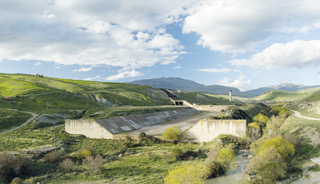
Blufi Dam, Palermo, 2018, Credits Alterazioni Video “The Incompiuto has been the leading architectural style in Italy since World War II” (Alterazioni Video, 2008). Far from being a provocation, Incompiuto refers to over 700 unfinished public works across Italy—architectural and infrastructural projects abandoned before completion. Widely debated, these structures raise persistent questions about their future. This paper interprets Incompiuto (Alterazioni Video, 2008) as a paradigmatic practice of “site responsiveness”, understood as a critical re-reading of site-making processes. By framing unfinished works as an architectural “style,” the project re-signifies them from symbols of failed modernity into a coherent aesthetic landscape. In a Foucauldian sense, Incompiuto operates as a dispositif, revealing how local incompletion reflects broader systemic crises rooted in financial, administrative, and historical conditions, exposing the gap between bottom-up needs and top-down provision. Within architectural discourse, these works form an autonomous field of research linked to drosscapes, contemporary ruins, and adaptive reuse, and can be seen ecologically as “Fourth Nature.” Ultimately, Incompiuto foregrounds unfinished sites as dynamic landscapes, offering a critical lens on a widespread, century-long heritage.
Veronica Caprino is an architect and a co-founder of the research and design collective Fosbury Architecture. She is currently a postdoctoral researcher at NABA, Milan, focusing on the relationship between commons, performative architecture, and practices of care.
- 10:20–11:10
-
Across Architecture and Sculpture: Consagra’s Frontal Theatre as a Responsive Practice
Stefano Setti Ludovica Tomarchio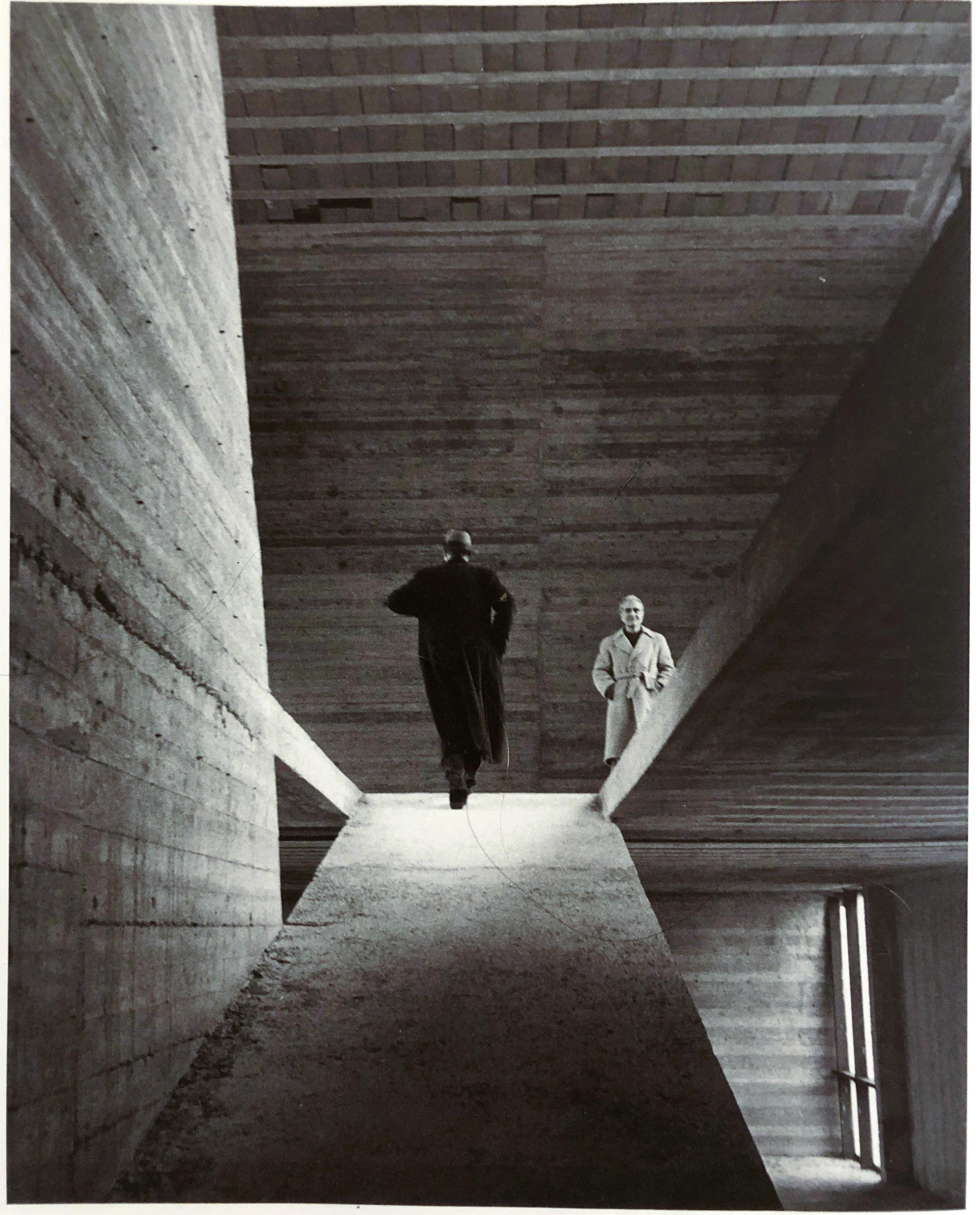
Joseph Beuys visits the Meeting, 1981, Credits Mimmo Jodice The presentation examines Pietro Consagra’s unfinished Frontal Theatre in Gibellina, Sicily, one of the few buildings realized by the sculptor, as a case of site responsiveness. The presentation argues that the Frontal Theatre of the Consagra should be read as a relational device, that would have allowed to stage the loss of the destroyed Gibellina, and performed its future. The relationality staged here is between bodies, bodies and objects, always preferring frontality as a non-hierarchical relation. But also to stage relations between the heterogeneous temporalities that traverse the site. At least five temporal regimes intersect in the theatre: the rupture of the seismic event, the projected future of a new civic subject informed by international art and architecture networks, the discontinuous time of administrative procedures, the material duration of concrete, and the accelerated temporality of the Città frontale, Consagra’s architectural manifesto. Responsiveness is the capacity to activate and hold together conflicting processes.
Stefano Setti holds a Ph.D. in Contemporary Art History and is an Adjunct Professor at the University of Bologna and at Politecnico of Milan. Since 2025 he has been research advisor of Archivio Pietro Consagra, Milan.
Ludovica Tomarchio is a postdoctoral researcher in architecture theory at the Berlin University of the Arts (UdK), where she is part of the NOMIS-funded research project “Site Complexes: Responsive Practices for the 21st Century”.
- 11:10–11:40
-
Coffee Break
- 11:40–12:30
-
Instrumentalising Typology: Protest near the Protocol Villa
Alexandra-Elena Burtea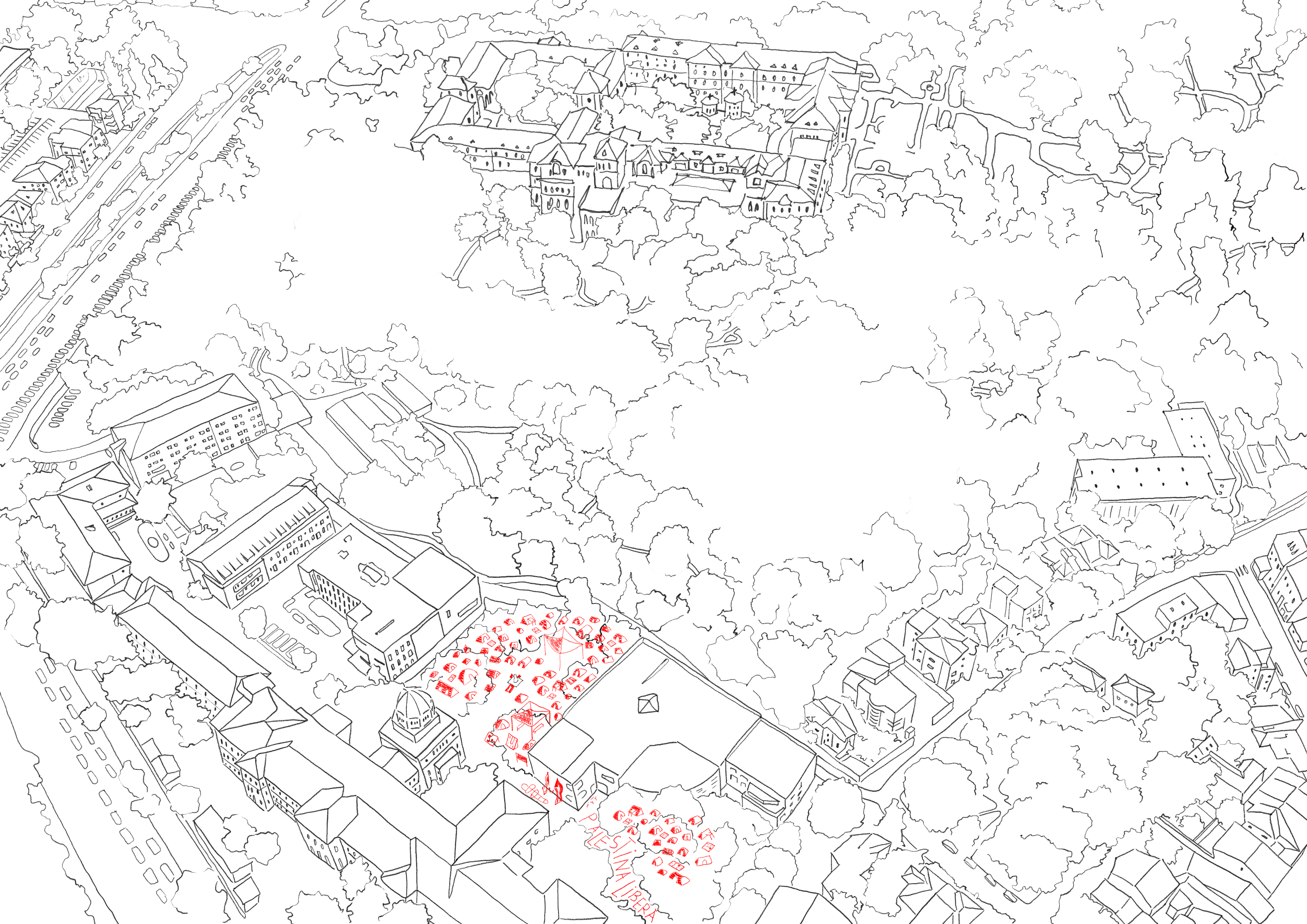
Protest near the Nomenklatura, Credits Alexandra Elena Burtea This paper examines social protest as an architectural instrument whose assemblages do not merely occupy sites but actively reconfigure them: as a research opportunity for architectural knowledge. It proposes protest as a civic opportunity of reading the openness of space. Following the 2024 Romanian reiteration of Occupy, that took place at the UNIBUC’s Rector’s office, in proximity to the former nomenklatura villa, the paper studies protests as hybrid spaces, regional appliances of transnational logics. Their architecture becomes epistemologically universal not because it is placeless, but because it invariably challenges pre-existing typologies and urban logics — disrupting inherited assumptions by which space is governed. The placeness of the urban protest lies in the context-specific deconstruction of entrenched representations of space that ascribe to architecture types. In this capacity, protest functions as a generative method of imagining otherwise — as a counter-method for knowledge production: a set of situated tools operating within trans-local interdependencies.
Alexandra-Elena Burtea is a PhD researcher, architect, and teaching assistant at UAUIM, Bucharest, who studies protest architecture and has a strong academic and civic commitment to architecture’s social development.
- 12:30–13:00
-
Panel Discussion moderated by Susanne Hauser
- 13:00–14:00
-
Lunch Break
- 14:00–14:50
-
Plots and Counterplots: Interrogating Site through Land and Narrative
Iris Giannakopoulou George Papam Clare Fentress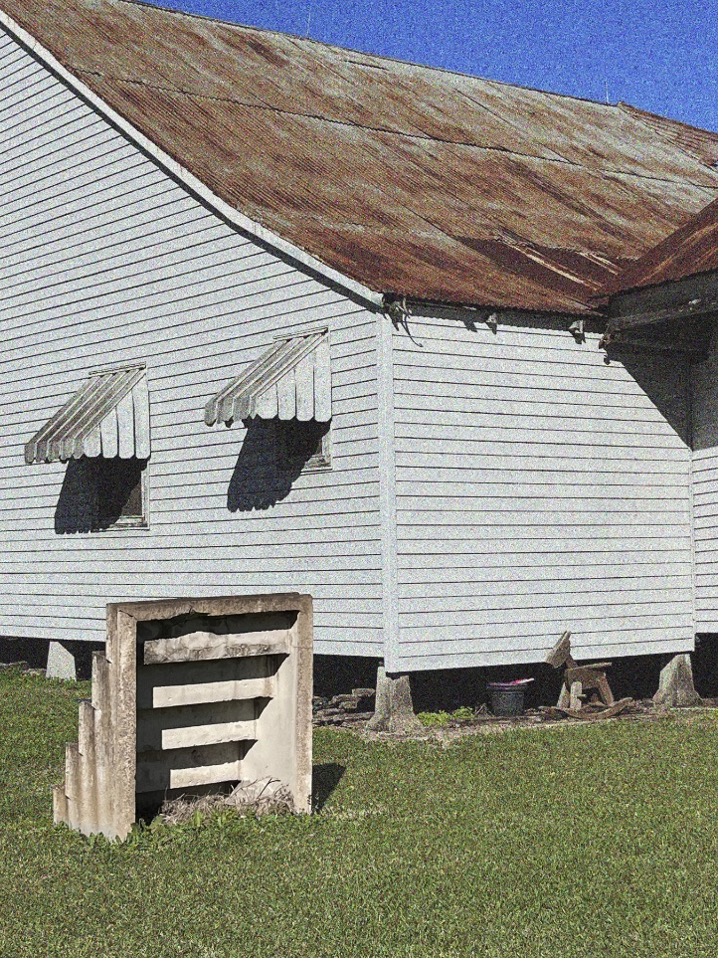
Credits Uzayr Agha Architectural discourse typically treats site as a given: a discrete, legible unit whose physical conditions precede design. But what architecture encounters as “site” is ground already measured, divided, and named. To account for this prior work, we turn to the figure of the plot. The term’s double meaning—a tract of land and a structured narrative—is not metaphorical but genealogical, both senses coalescing in early modern surveying practices that rendered land legible through lines, grids, and scripts. From enclosure and plantation geographies to cadastral mapping and speculative real-estate markets, plots have partitioned land while scripting its uses, values, and futures. Yet counterplotting practices, such as the reparative work of the Descendants Project, a frontline environmental justice initiative in Louisiana, USA, show how these inherited conditions can be reworked. By theorizing plotting and counterplotting as the intertwined production of land and narrative, design emerges as a practice capable of intervening in the material and immaterial conditions that produce a site.
Iris Giannakopoulou, PhD, is an architect and architectural historian whose research examines architecture, politics, and institutional power in the twentieth century.
George Papam is a PhD candidate in Geography at Queen Mary University of London, interested in extended urbanization, decarbonization infrastructure, and environmental management.
Clare Fentress is a designer and writer concerned with architecture, labor, and caretaking space. She is a member of the design collective Acritarchy and an associate editor at n+1.
- 14:50–15:40
-
Stolen land and disappearing reefs: the techno-ecological Paradox of reclamation practices in the Maldives
Beatrice Azzola Annalisa Azzola Irene Pancrazi Hassan Ahmed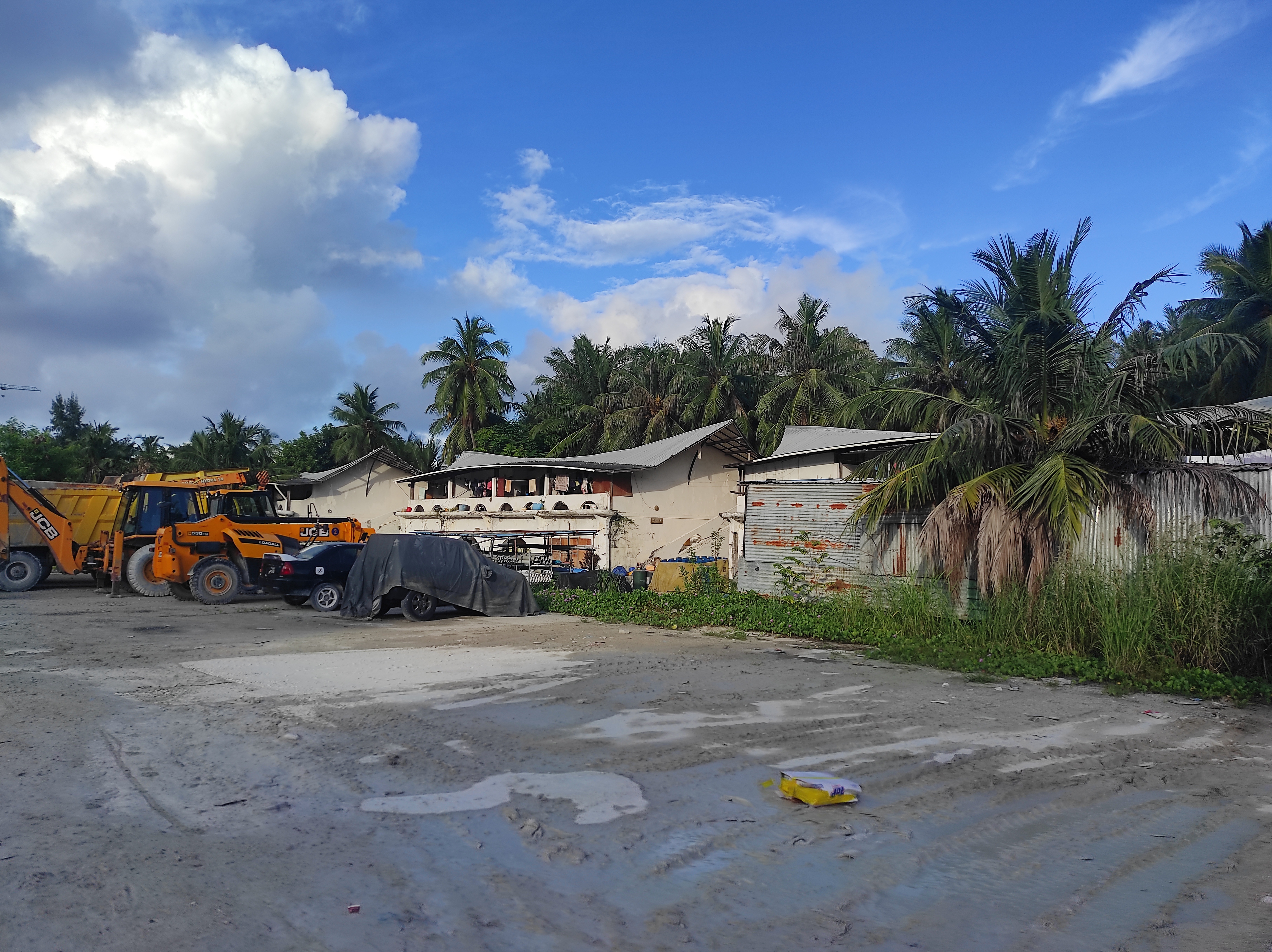
Resort “Heritage Island” on Farukolhufushi, 2023, credits Irene Pancrazi Land reclamation as a practice to address the scarcity of buildable land has been widespread in the Maldives since the early 2000s. It involves transporting large quantities of sand from offshore and using it to fill atoll lagoons. Its purpose is to enlarge the islands and enable urban and economic expansion, often overlooking the social and environmental pressures on local communities and ecosystems. The impact on coral reefs is devastating, as reclamation removes the protective action and ecosystemic function of corals, distorts the natural profiles of islands, and makes them more vulnerable to the erosion processes it was intended to address. In our case study, we aim to understand how economic motivations for growth conflict with ecosystemic well-being, and how taking land and altering sand movements result in a techno-ecological paradox. The Maldivian island emerges as a contested site where development and ecological loss are inseparably entangled.
Beatrice Azzola is a research associate at ZZF Potsdam. She holds a PhD in Architecture from Politecnico di Milano and studies infrastructure, landscape, and contemporary architecture history.
Annalisa Azzola is a marine ecologist and research fellow at the University of Genoa. Her work focuses on coastal ecosystems, ecological monitoring, anthropogenic impacts, scientific diving, and photographic sampling.
Irene Pancrazi is a marine biologist specializing in tropical environments and coral restoration. Since 2016, she has worked with Save the Beach Maldives, developing restoration protocols and supporting scientific research.
Hassan Ahmed is a Maldivian environmentalist, coral scientist, and founder of Save the Beach Maldives. He promotes sustainable development, community education, coral relocation, and reef restoration across the Maldives.
- 15:40–16:00
-
Panel Discussion moderated by Stefan Neuner
- 16:00–16:30
-
Coffee Break
- 16:30–17:20
-
Global Weather, Global Networks: Translocal Connectivity in Telecopy Art
Léa Dreyer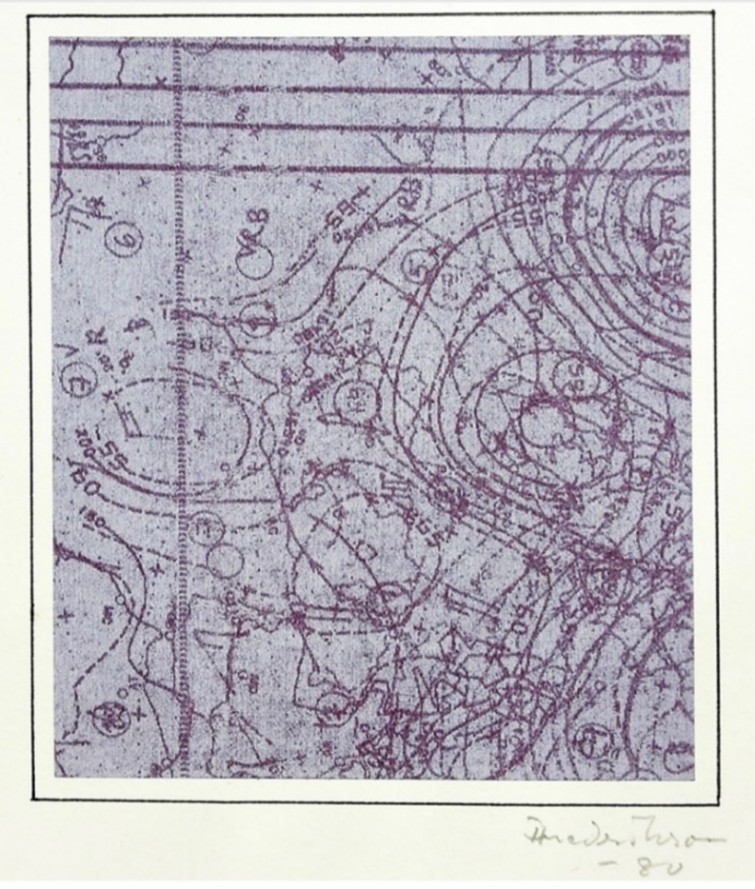
Lars Fredrikson, Untitled, 1980. Mounted print on paper, 43.7 x 33.5 cm, Galerie In Situ-Fabienne Leclerc, Paris This paper takes as its point of departure a series of telecopied weather reports intercepted and reworked by Swedish artist Lars Fredrikson between the mid-1970s and the 1990s, examining how these images and their telecommunication networks destabilize notions of place and representation. Situating them within broader cultural reflections on the Earth as a medium, the paper highlights the growing interdependence between territorial control, climate systems, and infrastructures of data collection and modelling in the late twentieth century. Against this backdrop, while these cartographic images appear to promise immediacy and objectivity, they visually expose both the abstract conventions of calculation and representation and the materiality of the infrastructures that sustain them. Through a media-archaeological approach, the paper extends the concept of media meteorology to describe how such images intensify awareness of climatic interdependence while contributing to a dislocation of place and time, whereby site emerges through processes of mediation and circulation.
Léa Dreyer (University Paris 1 Panthéon-Sorbonne) is an art historian specializing in sound and media art practices. Her PhD dissertation focused on the work of Lars Fredrikson (1926–1997).
- 17:20–18:10
-
Non-Site Answerability: Adrián Villar Rojas’s Figuration of Sculptures
Simon BaierThis paper takes Adrián Villar Rojas’s ongoing sculpture series The End of Imagination (2022–present) as a starting point to examine how “site” is articulated in contemporary global artistic practice. Rather than responding to a specific physical or social locale, Villar Rojas employs a “Time Engine”—a system combining machine learning and game engines—to simulate environmental and sociopolitical conditions for sculptural models dissociated from the artist’s hand. Since 2021, these computationally generated, time-traveling virtual sculptures have been “downloaded” and reconstituted physically at institutions ranging from the Art Sonje Center in Seoul to the Art Gallery of New South Wales. The paper argues that this procedure inverts the logic of Rosalind Krauss’s “Sculpture in the Expanded Field” (1979) by digital means Krauss explicitly excluded from critical modernist discourse. This reversal of site-specificity, the paper contends, is the direct result of the concept of the planetary as a controllable system in the age of global environmentalization.
Simon Baier is Associate Professor of Art History and Visual Studies at the University of Oslo, previously at the Universities of Basel, Vienna, and Zurich.
- 18:10–18:30
-
Panel Discussion moderated by Christoph Chwatal
- 19:30
-
Dinner (for contributors only)
Saturday, June 13, 2026
- 09:00–09:50
-
When Infrastructure Forecloses the Future: Responsiveness and Generational Sovereignty
Erika BrandlRecent debates on site responsiveness in policy and architecture frame responsiveness in terms of efficiency, adaptation, or sustainability. While these paradigms foreground adjustment to environmental, economic, or infrastructural conditions, they often overlook the temporal asymmetries through which sites are constituted, governed, and occupied. This paper proposes temporal sovereignty — or, to recuperate a term used in intergenerational scholarship, generational sovereignty — as an alternative and necessary conceptual lens for theorizing site responsiveness beyond architectural performance. Generational sovereignty entails a normative focus on who controls and whose capacities for response are preserved or curtailed over time, foregrounding autonomy, rigidity, and non-domination, and prompting infrastructural makers to better account for long-term effects. The paper argues that responsiveness should be assessed by the extent to which practices maintain a site’s openness to future reinterpretation, recalibration, and contestation. Examining three sites, it develops a framework distinguishing responsive interventions from temporal “enclosure,” where present actors consolidate control over long-term trajectories.
Erika Brandl is an architect and a doctoral candidate at the University of Bergen, Norway. Her research focuses on intergenerational relations, basic needs and policy, and sovereignty.
- 09:50–10:40
-
Critical Regionalism and Adaptive Reuse in the Case of Massimo Carmassi in Pisa
Andrea Crudeli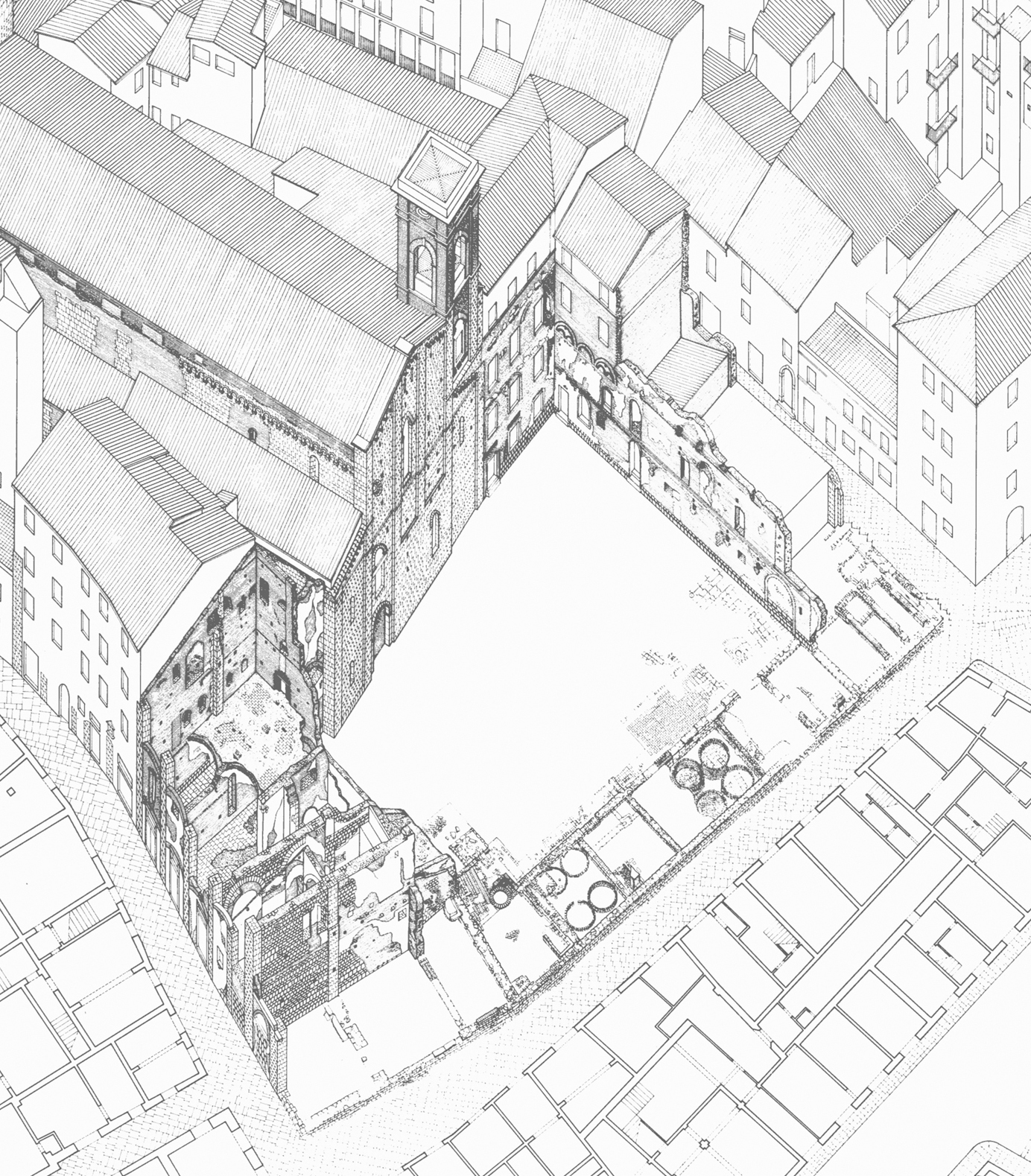
Reuse of the Rear of San Michele in Borgo in Pisa Massimo Carmassi Archive of the Municipality of Pisa Building on Kenneth Frampton’s notion of topology, this study understands urban repair as a critical practice of adaptive reuse in which historical fabric, ruin, and contemporary habitation enter into dialogue. It examines the reconstruction of the rear cloister of San Michele in Borgo, Pisa, a Benedictine convent devastated by the 1943 bombing, which left a void between the church apse and the surrounding streets. From 1974, architect Massimo Carmassi pursued a long-term project to transform this post-traumatic gap into a public complex of social housing, reintroducing working-class dwelling into a symbolically charged and speculative historic center. Through archival research on ten design variants produced between 1974 and 1986, the analysis traces a reparative trajectory in which the ruin becomes an active matrix for design. Repair is thus reframed as site-responsive mediation across war, heritage, and social justice in the historic city.
Andrea Crudeli holds a Ph.D. from the University of Pisa. He is currently a visiting research fellow at Chiba University, Japan. Crudeli is a founding partner of the architecture firm Dedalo Building Lab.
- 10:40–11:00
-
Panel Discussion moderated by Sebastian Egenhofer
- 11:30–12:20
-
Patchy Panoramas: Architecture as Expanded Landscape
Alicia Lazzaroni Antonio Bernacchi Anna-Lena Mueller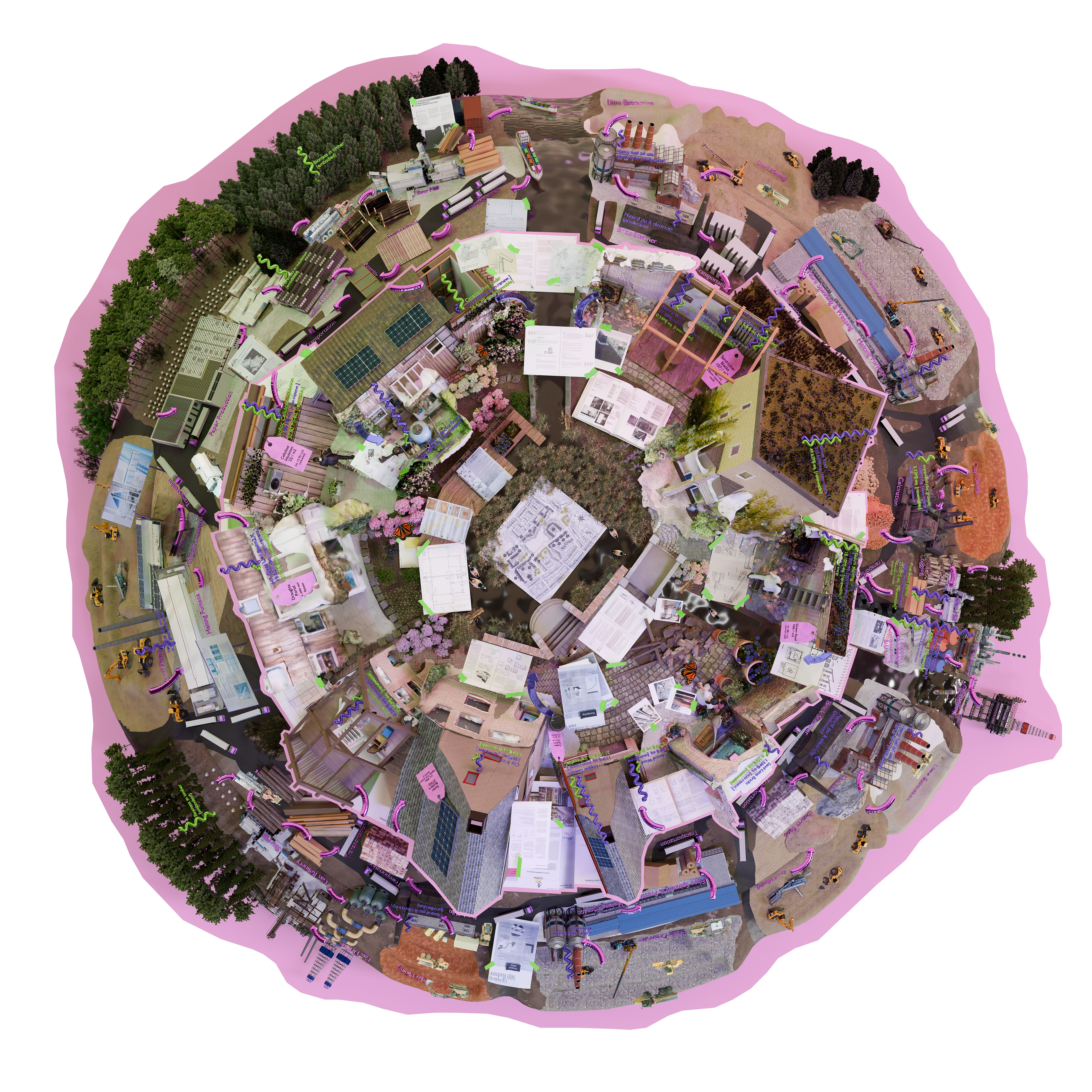
Mapping of Ecolonia, 2026, Credits Alicia Lazzaroni Antonio Bernacchi Anna-Lena Mueller How could approaching buildings as expanded landscape patches shift how we read architecture as multi-sited, multi-scalar, and more-than-human? Understanding the impacts of the Anthropocene requires observing technological, biological, and socio-political processes in which human and nonhuman trajectories intertwine, particularly in infrastructural landscape patches, which Anna Tsing proposes approaching through “patchy epistemics”. This perspective foregrounds representation—especially mapping—as an active form of world-building. Here, flattened panoramas serve as useful hybrid precedents, combining architectural and landscape viewpoints and integrating orthographic drawing, perspective, diagrams, and text into immersive narratives. These ideas are examined through a mapping of the ecological pioneering development of Ecolonia in Alphen-aan-den-Rijn, masterplanned by Lucien Kroll. The mapping attends to buildings as assemblages that are multi-spatial (on-site and off-site effects), multi-scalar (untangling components), and multi-temporal (including dynamic processes). A multi-observational, multi-media method juxtaposes technical documentation, anecdotes, 2D drawings, diagrams, 3D models and scans, specifications, and photographs to condense this distributed complexity.
Alicia Lazzaroni is Teaching Associate Professor at Arkitektskolen Aarhus, co-founder of the design practice Animali Domestici. Her work and pedagogy are rooted in ecology and post-anthropocentric approaches.
Antonio Bernacchi is Teaching Associate Professor at Arkitektskolen Aarhus, co-founder of the design practice Animali Domestici. His main interests span manufactured imaginaries and design fiction from an ecological critical perspective.
Anna-Lena Mueller is Research Assistant at Arkitektskolen Aarhus. Her interests focus on the relationship between architecture, landscape, and digital technologies, particularly as they unfold within contested social or ecological contexts.
- 12:20–13:10
-
From Taskspace to Tectonics: Surveying the Carrière de Crozet
Emma Kaufmann LaDucFrom the site of a former limestone quarry, the Carrière de Crozet, photogrammetry and LiDAR document where deep geological time intersects with short-lived extraction and labour. Repeated visits and virtual engagement generate high-resolution point clouds and topographic models that register sedimentation, stratification, and the traces of excavation. Drawing on Doreen Massey’s insistence of place as constituted through potentially differential effectivities of contrasting temporalities, the quarry embodies a conflict between the temporalities of the taskspace and the temporalities of tectonics (Massey 2006). Surveys promise precision and completeness, yet they cannot recover the movements, transformations, and absences that extraction produced. Alongside these dense, granular, time-agnostic models, a hand-carved volumetric reconstruction of the removed limestone shifts modelling toward labour and material resistance. What the digital survey cannot capture becomes productive: a way to read site responsiveness through time, absence, and matter rather than through complete representation.
Emma Kaufmann LaDuc is an architect and landscape architect based in Zurich. She currently works as researcher at the Chair of Affective Architectures, ETH Zurich, and is founder of studio PASS.
- 13:10–13:30
-
Panel Discussion moderated by Ludovica Tomarchio
- 13:30–14:00
-
Coffee Break and Closing Session